Introduction
Many Chinese studying, working or traveling in New Zealand still prefer using Didi Chuxing for daily travel, but often encounter issues like app crashes or loading failures. Such problems stem from multiple factors rather than a single cause, requiring troubleshooting from perspectives like network environment and regional restrictions. This article will break down the root causes technically and provide practical, professional solutions.
Core Causes: Regional Service Restrictions and Network Adaptation Issues
Didi Chuxing's service coverage is mainly concentrated in mainland China and some overseas areas with dense Chinese populations, and New Zealand is not included in its official service territory. Its server clusters detect user locations via IP addresses, and if determined to be outside the service area, core app functions will be directly restricted from loading.
Meanwhile, the routing policies of local New Zealand operators may cause packet loss or excessive latency in connections between user devices and Didi's servers, triggering the app's loading timeout mechanism. DNS resolution services of some overseas networks may also fail to correctly point to Didi's domestic server addresses, causing domain name resolution failures.
Tip: Regional IP restrictions are a common issue when using domestic travel apps overseas, essentially a result of the platform's commercial service boundary settings.
Basic Troubleshooting: Resolve Loading Issues from Device and Local Network
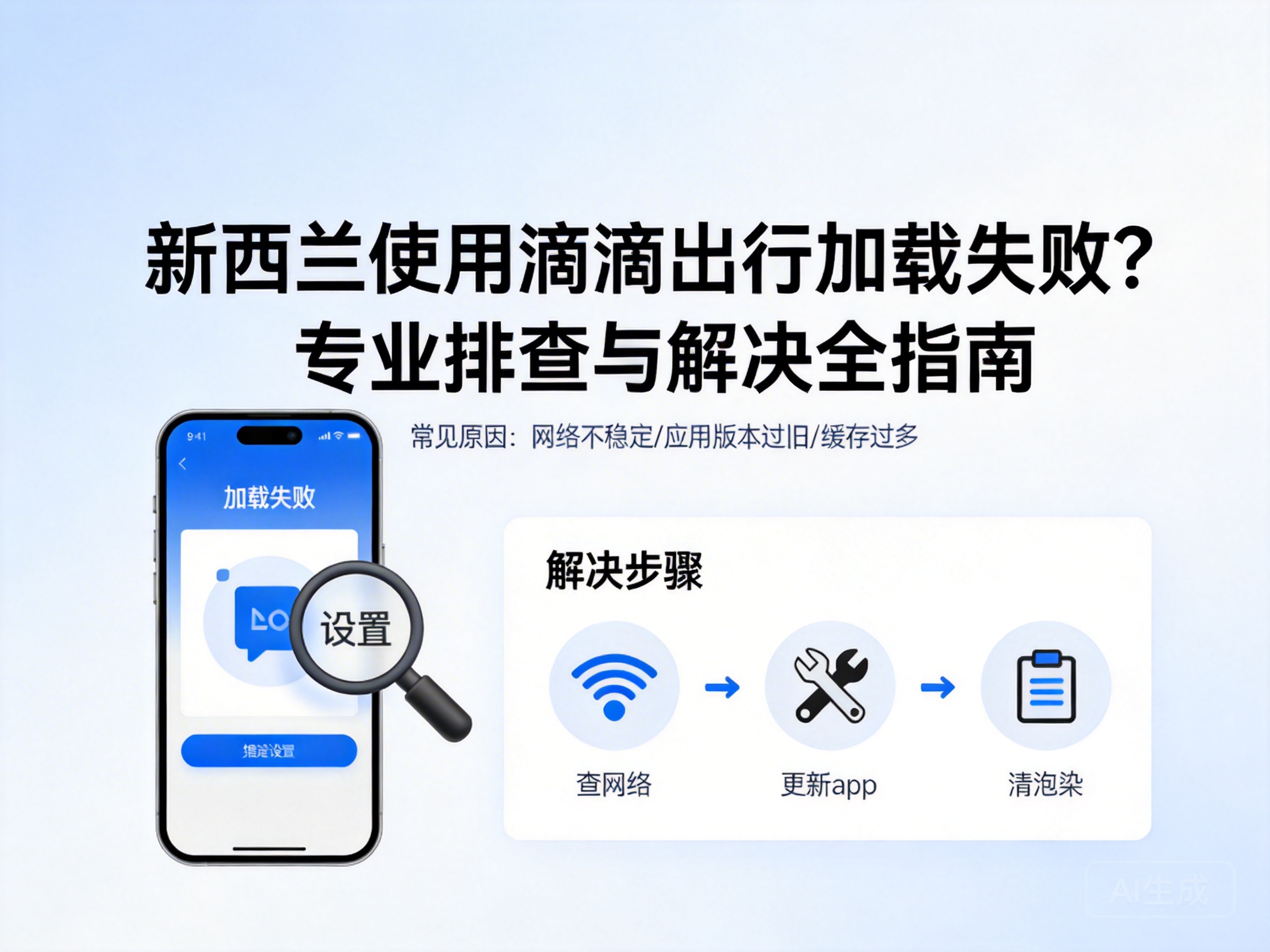
Before attempting complex solutions, complete basic troubleshooting steps to rule out occasional failures of devices or local networks. First, check the device's network connection status, switch to a local New Zealand 4G/5G network or stable WiFi environment, and avoid using public hotspots with weak signals.
Second, clear the cache data of the Didi Chuxing app, which can be done through the device's application settings. Accumulated cache may cause data conflicts during app loading. At the same time, ensure the app is updated to the latest version, as old versions may have unpatched overseas adaptation vulnerabilities.
- Close and restart the Didi Chuxing app, terminate background processes before restarting
- Check if the device's system time is synchronized with local New Zealand time
- Verify in the device's privacy settings that Didi has been granted location permissions
Advanced Solutions: Professional Technical Schemes to Break Regional Restrictions
If basic troubleshooting is ineffective, professional technical solutions are needed for IP regional restrictions. Currently, the most feasible method is using a Virtual Private Network (VPN) service. Choose a VPN provider with mainland China nodes, connect to a domestic server node, and disguise the device's IP address as a domestic one to bypass Didi's regional detection mechanism.
When selecting a VPN, prioritize providers with stable dedicated line channels, and avoid free VPNs. Such free services often have insufficient bandwidth and unstable nodes, which may cause slow app loading or frequent disconnections. At the same time, confirm the compliance of the VPN service in New Zealand to avoid violating local network regulations.
Tip: When using a VPN, choose domestic nodes with low latency, such as servers in South China or East China, to improve the app's loading response speed.
Alternative Options: Travel Alternatives When Solutions Fail
If the above methods fail to resolve Didi Chuxing's loading issues, consider local New Zealand travel services as alternatives. Uber is the most widely used ride-hailing platform in New Zealand, supporting Chinese interfaces and payments via Alipay and WeChat, with operating logic highly similar to Didi Chuxing for quick adaptation.
In addition, local New Zealand taxi companies such as Auckland Taxi and Christchurch Taxi offer both phone and app-based ride-hailing services, some with Chinese-speaking customer service. In popular tourist areas, Shuttle Bus services are also available, suitable for group travel or scenarios with large luggage.
Conclusion
The core cause of Didi Chuxing loading failures in New Zealand is regional service restrictions, which can be resolved gradually through basic troubleshooting and VPN technical schemes. If the issue persists, compliant local travel services can be used as alternatives. During operation, attention should be paid to the compliance and stability of VPN services, prioritizing travel convenience and safety.