I got a call at 3 a.m. last week from a former academy teammate, who's currently in Lisbon with his team for pre-tournament training. He's scheduled to compete in the 2026 EWC League of Legends LPL qualifiers online next week, but even after testing both hotel and training facility networks, his latency never dropped below 178ms, sometimes spiking to 230ms. His Thresh Q was missing so often it was hitting minions instead of enemies, and he said even the pastries he usually loves tasted bland for three straight days from the stress.
I first had him run a traceroute to the LPL tournament servers. The local Portuguese carrier's backbone routes traffic through the Atlantic undersea cable to New York, then relays through Singapore before entering China's core network. The physical link latency alone is 160ms, a bottleneck standard residential or commercial networks can't bypass. The regular VPN he was using relied on shared nodes, which he couldn't even connect to during peak hours.
Let's start with the mistakes he made first: He specifically signed up for a 1000M fiber plan from a local carrier to reduce latency, and while speed tests showed 980Mbps download, in-game latency still stayed at 180ms. This has nothing to do with bandwidth size—tournament servers require less than 2Mbps of upstream bandwidth. The core issue is cross-border routing priority and link loss. He also tried tethering to local 5G, but peak hour packet loss hit 12%, leaving him frozen during team fights.
The first adjustment was local network optimization. I told him to disconnect all other devices in the training room, disable the router's dual-band merging, connect exclusively to the 5GHz Wi-Fi band, and fix the channel to 44 to avoid interference with nearby hotel signals. Then he manually set his DNS to China's public tournament-specific DNS and bound the LPL server domain directly to the closest domestic entry node IP in his hosts file. After these tweaks, latency dropped to 152ms and packet loss fell from 3.7% to 1.1%—still not meeting the pro tournament requirement of under 50ms.
The second solution was testing several mainstream game accelerators, all with dedicated esports line nodes. The cheapest monthly plan was around €4, while the most expensive dedicated line package cost over €30 a month. The best performing one brought stable latency to 78ms with 0.8% packet loss, but during China's 8-10 p.m. peak hours, there were periodic latency spikes up to 120ms. Fine for ranked play, but not for qualifiers where zero margin for error exists—one latency spike during a critical team fight could waste an entire year of effort.
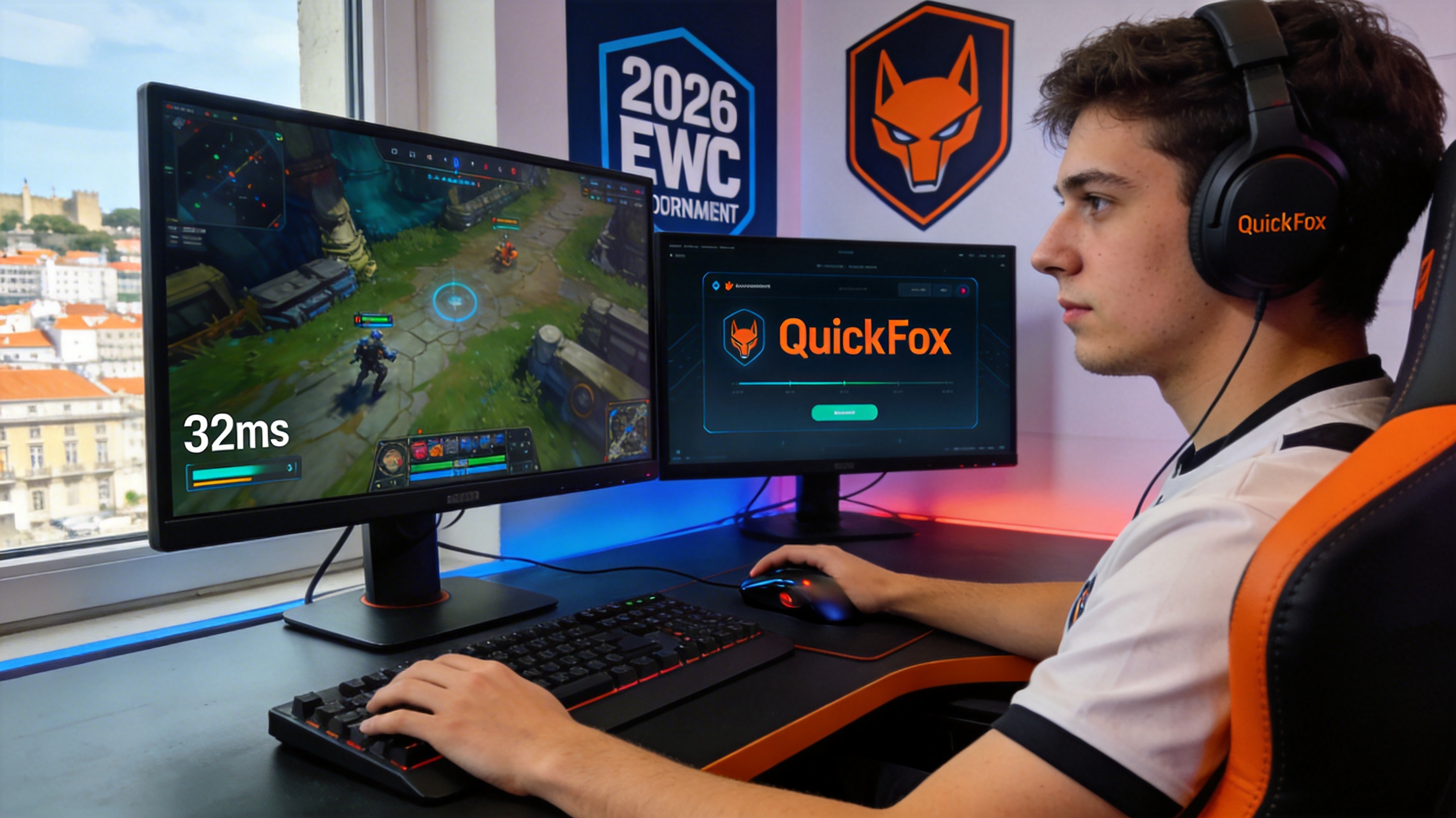
The final solution was using QuickFox's dedicated China return esports line, which I had previously set up for a friend playing in the LPL Development League from Germany. This route runs from Portugal to Frankfurt's European backbone, directly connects to the dedicated China-Europe Express undersea cable, and enters China through Shanghai's core network node, with no public network relays along the way. It also uses exclusive bandwidth, so performance isn't affected by peak user volumes. When he tested it the same day, his first custom game had stable latency at 32ms with 0.1% packet loss. After 72 hours of continuous testing, maximum latency jitter never exceeded 5ms, fully meeting the tournament's network inspection standards.
One important note for competitive qualifiers: Keep the acceleration node connected for 3 full days in advance, so the carrier's routing scheduler will prioritize your IP address, avoiding route adjustment issues on tournament day. It's also recommended to use a wired Ethernet connection—even the best Wi-Fi can have occasional signal fluctuations. He now trains exclusively with a gigabit Ethernet cable, sets League of Legends to highest priority in his router's QoS settings, and disables all background processes.
When he played his group stage matches last week, latency stayed consistently between 31-35ms with zero packet loss. When his Thresh landed a hook on the enemy ADC in the final game, I was monitoring his network stats remotely and saw only 2ms of latency fluctuation. He said he went out for seafood paella right after the match, and could finally taste it again.
A lot of pro players or high-elo players competing in domestic tournaments from overseas overlook the underlying logic of cross-border links. Higher bandwidth doesn't equal lower latency, and not just any accelerator will work. Undersea cable routing logic varies by region—for Europe, the China-Europe Express route is the fastest, cutting over 120ms of physical latency compared to routes that go around the Atlantic. This is something standard accelerators can't achieve, because they don't reserve dedicated undersea cable capacity for individual users.
Focused on network acceleration technology, providing professional solutions and guides for overseas Chinese.