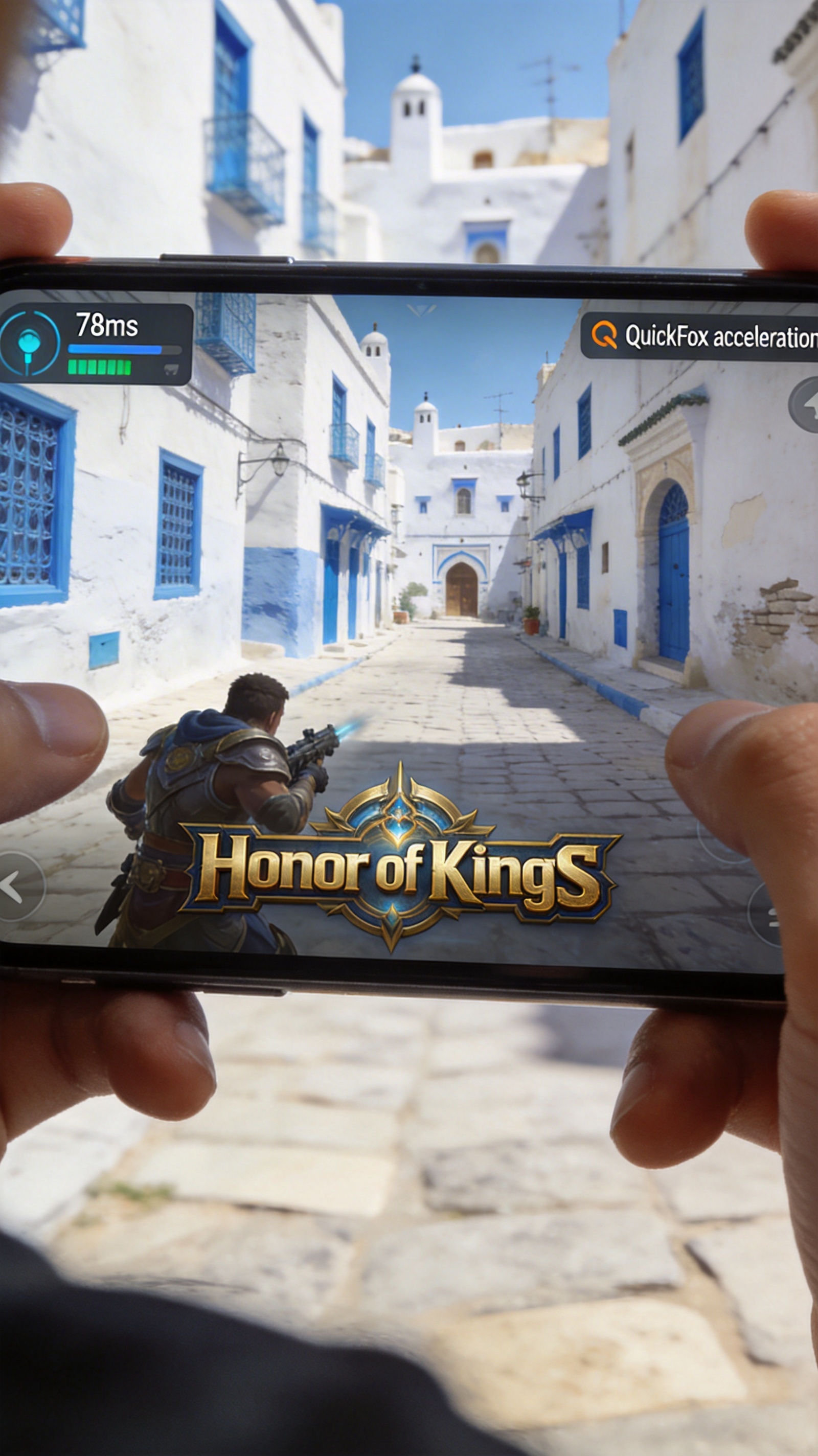
I worked in Tunisia on a foreign trade assignment for nearly half a year last year. I wanted to play a few rounds of Honor of Kings on weekends, and at first I didn't think much of it. I logged in directly with the local Orange 4G network, but the game loading interface took 2 minutes. After selecting heroes and entering the canyon, the ping immediately turned red at 280ms. I thought it was a network problem, so I subscribed to the fastest 500M fiber optic service locally, but it still didn't work. Every team fight would make the ping jump to 460ms, and by the time it recovered, our crystal was already destroyed.
During that time, I tried all the makeshift methods mentioned online: modifying the in-game network settings, placing the router less than a meter away from me, and even buying a gigabit Ethernet cable to connect directly to my computer and create a hotspot. At most, I reduced the average ping to 220ms, but it still fluctuated heavily. I would lag for three seconds every two steps, and as a marksman main, I couldn't reposition at all, even losing in Gold rank matches.
Later, I asked friends who play Chinese server games in the Middle East and found out that the problem wasn't the local network at all. All Honor of Kings servers are located in China, so the physical link from Tunisia is extremely long, requiring data to pass through several transit nodes, with inherent transmission loss. During peak hours, node congestion causes ping spikes and packet loss, which ordinary network optimizations can't solve at the core.
I tried four different acceleration tools one after another, running into pitfalls twice: either I couldn't connect to the nodes, or the ping remained above 180ms even after acceleration. It wasn't until I switched to QuickFox that I saw improvement. The first time I connected, I specifically tested it: selecting the exclusive Chinese server game node, the in-game ping showed 76ms immediately. I thought it was fake at first, so I played a ranked match for 20 minutes. The ping fluctuation never exceeded 10ms the entire time, and casting skills and repositioning felt exactly the same as playing in China. I even pulled off a perfect Luna ultimate combo without interruption.
Later, I specifically monitored the acceleration effect in different scenarios. Sometimes during local network peak hours in Tunisia, around 8 to 9 PM when everyone is streaming videos, the ping can reach 380ms without acceleration. With QuickFox enabled, it still stays below 90ms. I used to be terrified of receiving WhatsApp calls during peak ranked matches, as answering would immediately disconnect me. Now, with acceleration enabled, I can answer calls and switch back to the game in just two seconds to reconnect, never letting my teammates down.
One tip: don't randomly select nodes when using the tool. Choose the default exclusive Chinese server game line, not the general-purpose China return nodes. I tried general nodes before, and the ping was 30ms higher. Also, try to avoid accelerating over public WiFi. Many café WiFi networks in Tunisia restrict UDP transmission, so even with acceleration, you'll experience packet loss. Using your home fiber network or mobile 5G gives the best results.
I've already returned to China now, but several Chinese friends I met in Tunisia are still using this method. Last week we played a 5v5 match together, their pings were all stable between 80 and 90ms, no lag the entire time, and one of them even got a pentakill. Honestly, when playing Chinese server games overseas, there's no need to mess around with useless network settings. Choosing a suitable acceleration tool is way more effective than anything else.
Focused on network acceleration technology, providing professional solutions and guides for overseas Chinese.