Introduction
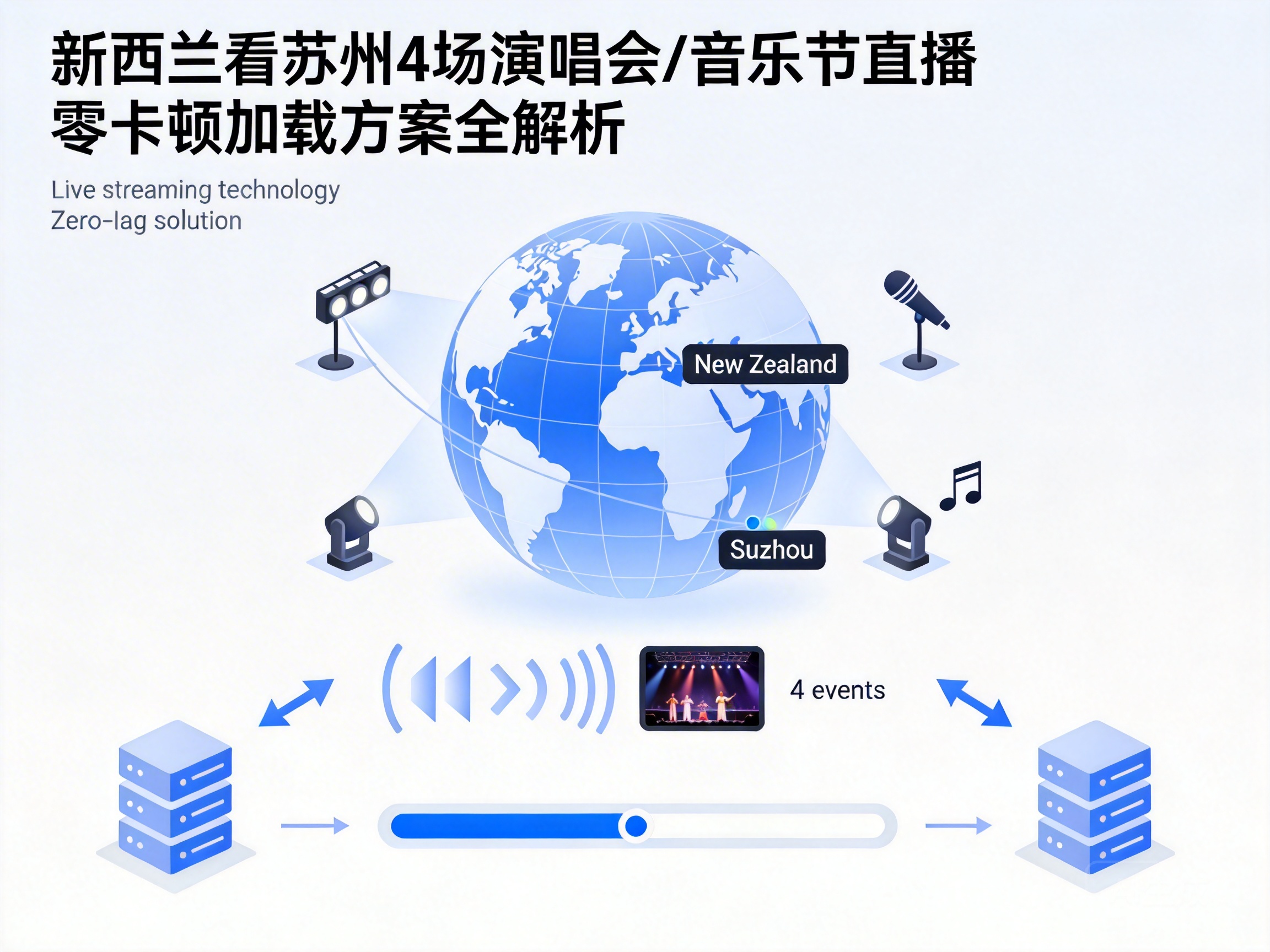
Chinese music fans in New Zealand are eagerly anticipating the online livestreams of 4 concerts and music festivals in Suzhou this week. However, the trans-Pacific network transmission distance often causes issues like buffering and loading failures. This article combines the principles of cross-border network transmission, providing actionable buffering-free solutions from the perspectives of devices, network optimization, and tool selection, helping users sync smoothly with this music feast.
Core Technical Causes of Cross-Border Livestream Buffering
The transmission link of Suzhou's local livestream signals needs to go through three layers: domestic operator backbone networks, international submarine cables, and New Zealand local ISP networks. Congestion or packet loss in any layer will cause loading delays. The direct network bandwidth between New Zealand and China is limited, and during peak hours, the bandwidth utilization rate of international links can reach over 90%, directly leading to unstable transmission of livestream code streams.
In addition, Geo-blocking by livestream platforms is a key obstacle: mainstream domestic livestream platforms identify user locations through IP addresses, and non-mainland China IPs will be restricted access or allocated low-priority bandwidth, further exacerbating buffering issues.
Industry data shows that the average packet loss rate of trans-Pacific cross-border livestreams is about 8%-12%, far higher than the qualified threshold of 0.5% for local livestreams.
Basic Network Environment Optimization: Pre-adjustments from Hardware to Settings
Before choosing professional tools, users can first improve network stability through basic optimization. First, switch to the 5GHz Wi-Fi band, which has less interference and a transmission rate 3-5 times higher than the 2.4GHz band, suitable for transmitting large-code-stream livestream content. If the device supports it, it is recommended to connect directly to the router via an Ethernet cable to avoid packet loss caused by wireless signal fluctuations.
Second, close bandwidth-consuming applications in the background, such as cloud disk synchronization, video downloads, and online games, to ensure the livestream gets the maximum bandwidth quota. At the same time, contact the local New Zealand ISP operator to confirm whether the current bandwidth package supports a stable downstream rate of 10Mbps or above—the minimum bandwidth requirement for 1080P HD livestreams.
Finally, modify the device's DNS server to a public DNS, such as Google 8.8.8.8 or Cloudflare 1.1.1.1, to reduce domain name resolution delay and improve platform connection speed.
Professional Network Tool Selection: Compliant and Efficient Cross-Border Access Solutions
For geo-restrictions and bandwidth congestion issues, Virtual Private Network (VPN) is currently the most mature solution, but it is necessary to choose a compliant service provider with dedicated mainland China nodes. Such VPNs switch the user's IP to mainland China through optimized cross-border dedicated links, while bypassing congested public international links, reducing the packet loss rate to less than 1%.
Users need to choose VPNs that support the UDP acceleration protocol. The UDP protocol has no handshake confirmation mechanism, making it more suitable for low-latency transmission of real-time livestreams. In addition, some professional cross-border acceleration tools (such as return-to-China dedicated line accelerators) have exclusive optimizations for domestic livestream platforms, which can automatically adapt to the platform's code stream requirements and have higher stability than general-purpose VPNs.
When choosing a tool, confirm that the service provider has local nodes in New Zealand and sufficient dedicated line bandwidth to avoid node congestion during peak hours.
Livestream Platform Adaptation and Video Quality Adjustment: Balancing Smoothness and Clarity
Different domestic livestream platforms have varying cross-border adaptation capabilities. Users can prioritize platforms that support HLS adaptive bitrate streaming. Such platforms automatically adjust video quality based on the user's real-time network conditions, avoiding buffering caused by bandwidth fluctuations. Platforms like Bilibili and Douyin Livestream have this feature.
If loading issues still occur, manually reduce the livestream quality from 4K to 1080P or even 720P. The required bitrate can drop from 15Mbps to 5Mbps, significantly reducing the pressure on cross-border bandwidth. At the same time, turn off interactive features like bullet comments and gift effects on the livestream page to reduce page resource usage and improve loading stability.
In addition, it is recommended to watch the livestream on a PC or smart TV. These devices have stronger network processing capabilities and can better cope with cross-border network fluctuations than mobile phones.
Peak Hour Emergency Solutions: Alternative Strategies to Avoid Congestion
The livestream peak of the 4 Suzhou shows is concentrated within 30 minutes after the start of the performance, when the bandwidth utilization rate of international links reaches its peak. Users can enter the livestream page 15-20 minutes in advance to complete video loading and IP verification, avoiding crowding into congested links during peak hours.
If all optimization solutions are ineffective, users can choose to watch secondary rebroadcast streams on third-party platforms. Some overseas Chinese communities will synchronize domestic livestream content to overseas platforms like YouTube and Twitch. These rebroadcast streams are hosted on local New Zealand servers, which can completely solve cross-border transmission issues, but it is necessary to confirm the copyright legality of the content.
In addition, if the platform supports it, enable the offline caching function to pre-cache the first half of the livestream content, then watch the subsequent content in real time, balancing real-time performance and smoothness.
Conclusion
For New Zealand users to watch Suzhou concerts and music festival livestreams, simultaneous adjustments are needed from three dimensions: basic network optimization, professional tool selection, and platform adaptation. The core is to solve the two major problems of cross-border bandwidth congestion and geo-restrictions. By switching to 5GHz Wi-Fi, choosing compliant dedicated line VPNs, and adapting to platforms with adaptive bitrate streaming, the livestream buffering rate can be minimized, allowing users to smoothly enjoy this hemispanning music feast.